Jet Charter Boston to New York
Jet charter Boston to New York is the fastest way to make the trip. The route covers 158 nautical miles, and a light jet spends about 41 minutes in the air. The real gain shows up before and after the flight, not during it.
- Start
- Route list
- Boston toward New York
- 158 nm182 miles
- 0h 51mturboprop travel time
- $2,200–$3,500single-leg estimate
Jet pricing Boston–New York by aircraft type
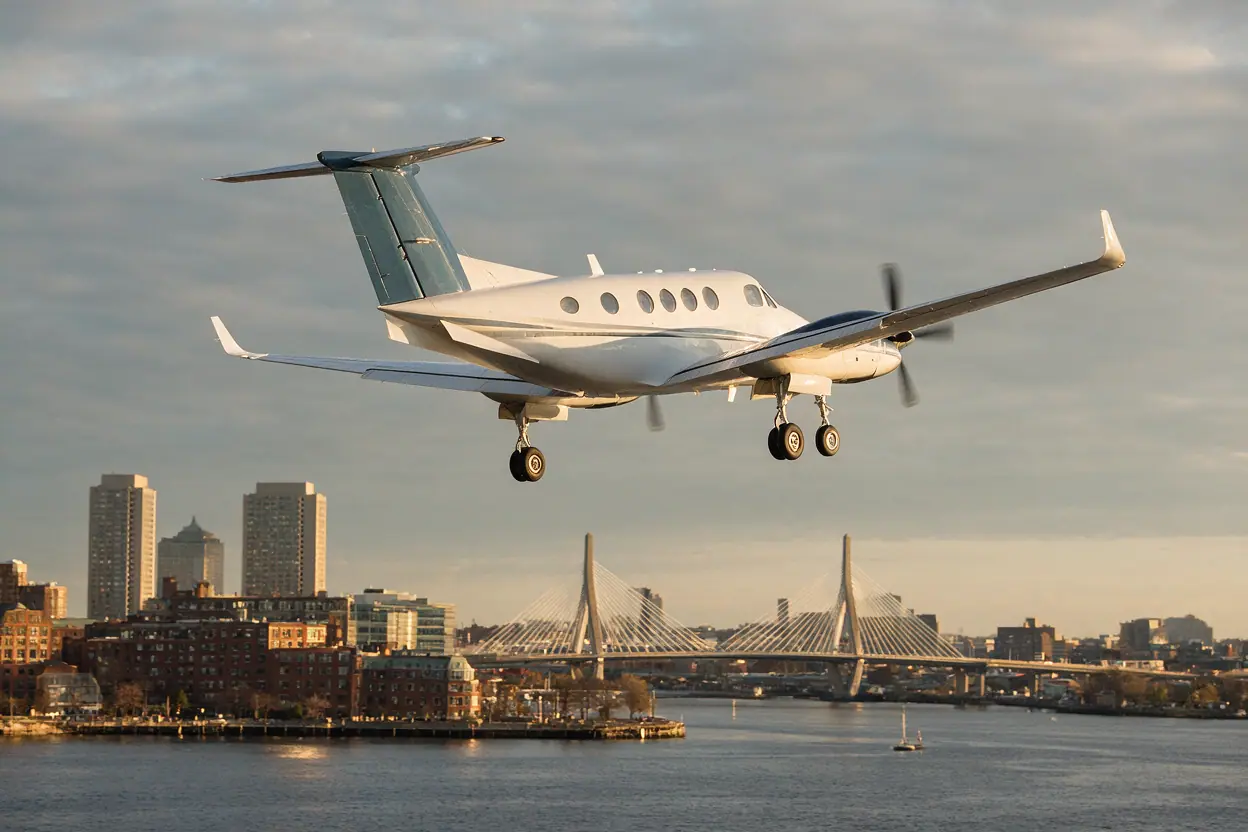
Flying private from Boston to New York takes a turboprop 0h 51m over 158 nautical miles, with a one-way estimate of $2,200–$3,500.The distance is short enough that cabin class changes very little in the air. What changes is the price, the baggage room and how many people you can bring. The figures below are estimates for the whole aircraft, not a per-person fare, and they move with aircraft availability on your dates.
| Aircraft class | Time aloft | One-way quote | Detail |
|---|---|---|---|
| Turboprop | 0h 51m | $2,200–$3,500 | Best fit |
| Light jet | 0h 41m | $4,000–$6,000 | Nonstop |
| Midsize jet | 0h 41m | $5,200–$8,000 | Nonstop |
| Super-midsize jet | 0h 39m | $7,200–$10,000 | Nonstop |
| Heavy jet | 0h 39m | $9,500–$14,500 | Nonstop |
Aircraft-level estimates, not per passenger, before federal excise tax and segment fees. Times cover taxi, climb and descent.
Airline fares beside a charter, Boston to New York
Airline figures are the lowest Google Flights fares for one traveller on Dec 9, 2026 (checked Nov 15, 2026); the charter line is our estimate for the entire aircraft. For 8 travellers, airline first class tickets total roughly $1,792, compared with $2,200–$3,500 for the whole turboprop.
| Way to fly | Operator | Flight time | One-way quote | Per seat |
|---|---|---|---|---|
| Economy on a commercial airline | JetBlue · nonstop | 1h 17m | $154 | $154 |
| Airline first class | Delta · nonstop | 1h 33m | $224 | $224 |
| Turboprop | The entire jet, seating up to 8 | 0h 51m | $2,200–$3,500 | $280–$440 |
Airline ticket prices shift daily and don't cover bags past the fare's limit; the per-seat charter number presumes all seats are taken.
Leaving Boston
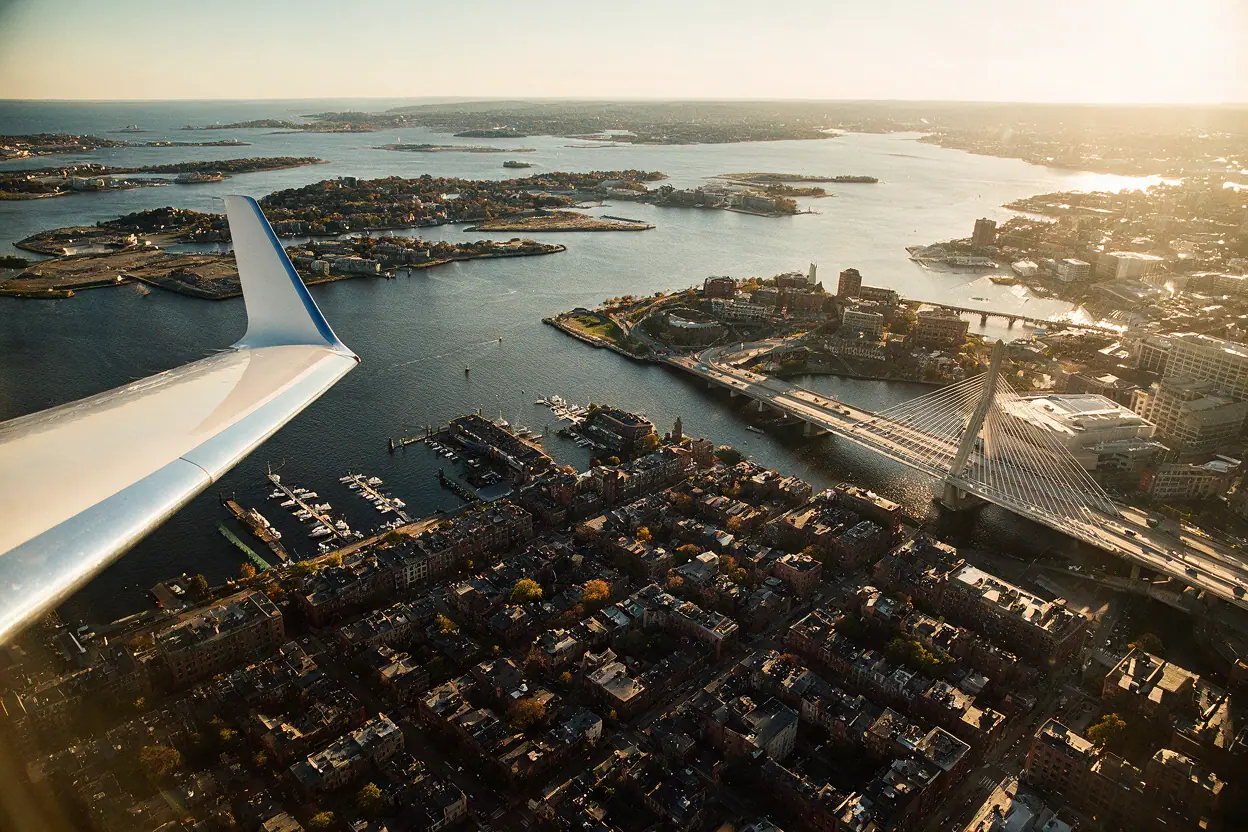
Boston departures usually begin at Laurence G Hanscom Field in Bedford, a 7,011-foot runway field west of the city that avoids Logan's terminal traffic entirely. Boston Logan International Airport works too, with a 10,083-foot main runway and the most airline competition, though you trade a private terminal for a busy commercial one.
If your morning starts in Cambridge or the Seaport, then Logan is the shorter drive and the easier choice for an early wheels-up. If you are coming from the western suburbs along Route 2 or I-95, then Hanscom saves you the tunnel and the downtown crawl. Either way, arrive at the FBO a few minutes before your slot, not an hour. From Bedford or Logan, a turboprop reaches New York airspace in under an hour of flight time, so the ground plan matters more than the air plan.
Arriving in New York
New York arrivals split across four fields, and the right one depends on where your day happens. Teterboro Airport in New Jersey has a 6,997-foot runway and is the classic Manhattan-side arrival. LaGuardia has 7,002 feet and sits closest to Midtown and the Upper East Side. Newark Liberty brings 11,000 feet of runway for larger aircraft. Morristown Municipal, at 5,998 feet, suits meetings in northern New Jersey.
If your first stop is a Midtown office, then LaGuardia or Teterboro puts you on the ground closest to it. If the day is in Princeton or the Morristown corridor, then Morristown Municipal is the sensible landing. For a Manhattan morning meeting, a Teterboro arrival puts you on the West Side in roughly half the time of the airline shuffle, counting the walk, the train and the terminal.
Note the direction of this page: it is written for travelers flying into New York from Boston. The same logic runs in reverse for the return leg across the same four airports.
| Field | ID | Rwy |
|---|---|---|
| Laurence G Hanscom Field | KBED / BED | 7,011 ft |
| Boston Logan International Airport | KBOS / BOS | 10,083 ft |
| Teterboro Airport | KTEB / TEB | 6,997 ft |
| Morristown Municipal Airport | KMMU / MMU | 5,998 ft |
| LaGuardia Airport | KLGA / LGA | 7,002 ft |
| Newark Liberty International Airport | KEWR / EWR | 11,000 ft |
How a turboprop suits your trip
On 158 nautical miles, a light jet is the sensible pick for most travelers from Boston. It flies the route in roughly 41 minutes, carries a useful amount of luggage, and lands short of the runway lengths needed by larger types, which keeps more airports open at the New York end. Prices start around $4,000 and climb toward $6,000 when the calendar is busy.
A turboprop trims the cost further, from about $2,200 to $3,500, and needs only a few more minutes in the air. A midsize jet adds cabin room for a team and runs roughly $5,200 to $8,000. Super-midsize and heavy jets on this distance are about comfort and presence rather than speed, since the airborne time barely moves.
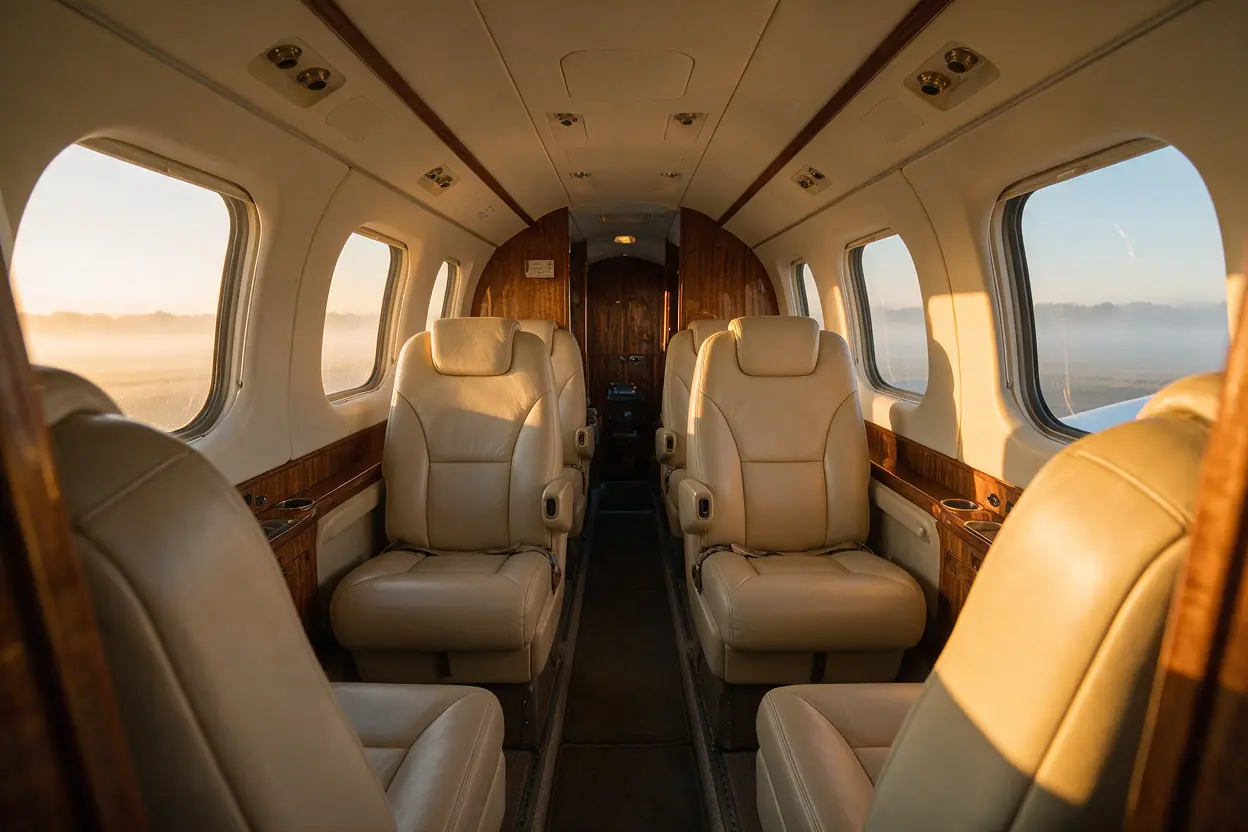
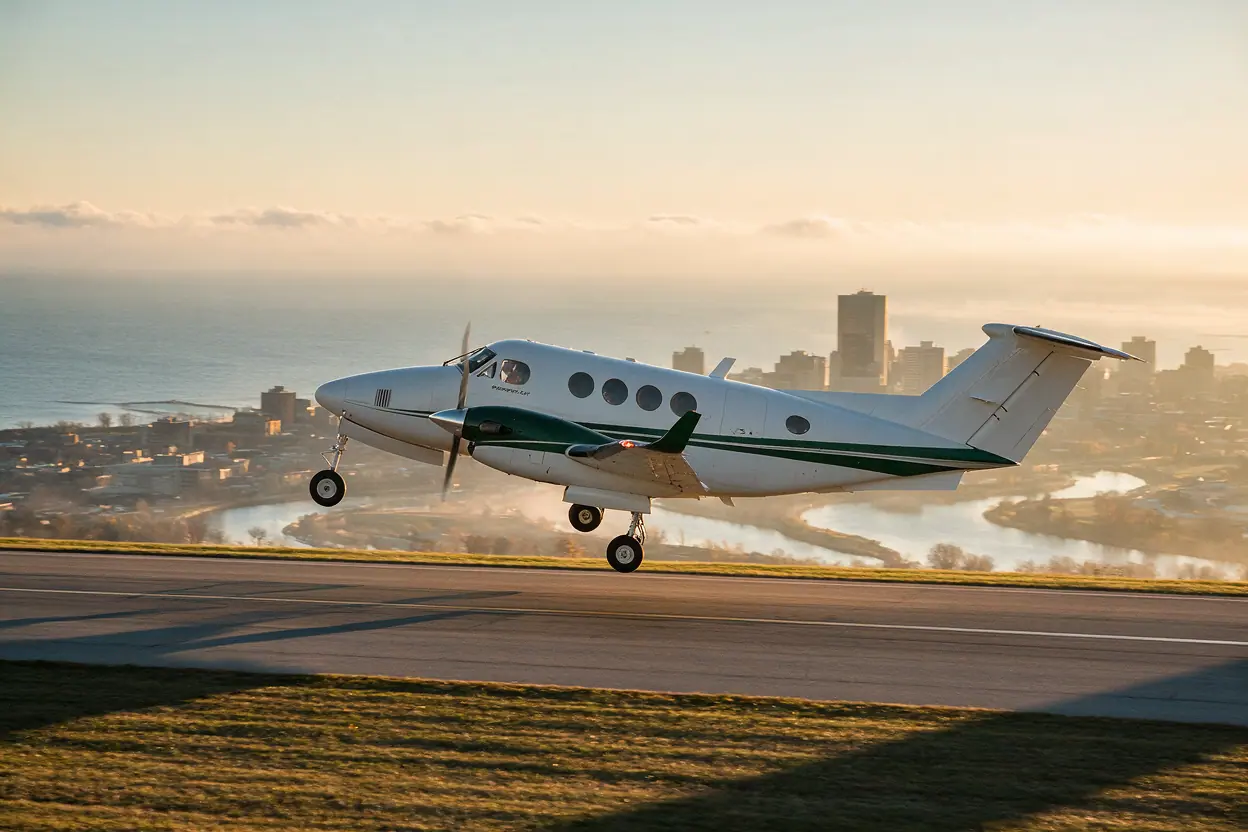
The recommended cabin for this city pair is a turboprop, which fits the short-hop band better than anything larger. A turboprop flies Boston to New York in about 0h 51m at an estimate from $2,200, and no jet on the list saves you more than a handful of minutes. The Daher TBM 960 seats six and cruises at 330 knots; the Beechcraft King Air 350i carries eight with 55 cubic feet of baggage.
Both aircraft types keep the flight cheap on a distance where jet time is nearly fixed. If your party is larger than six, then the King Air 350i handles eight without stepping up to a jet price. If you need stand-up cabin space, then a midsize or super-midsize jet is the natural alternative, at a higher estimate for very little time saved.
One practical note: the turboprop's quieter field requirements open smaller New York-area airports that jets with longer runway needs may skip. That matters when your meeting sits closer to Morristown than to Manhattan.
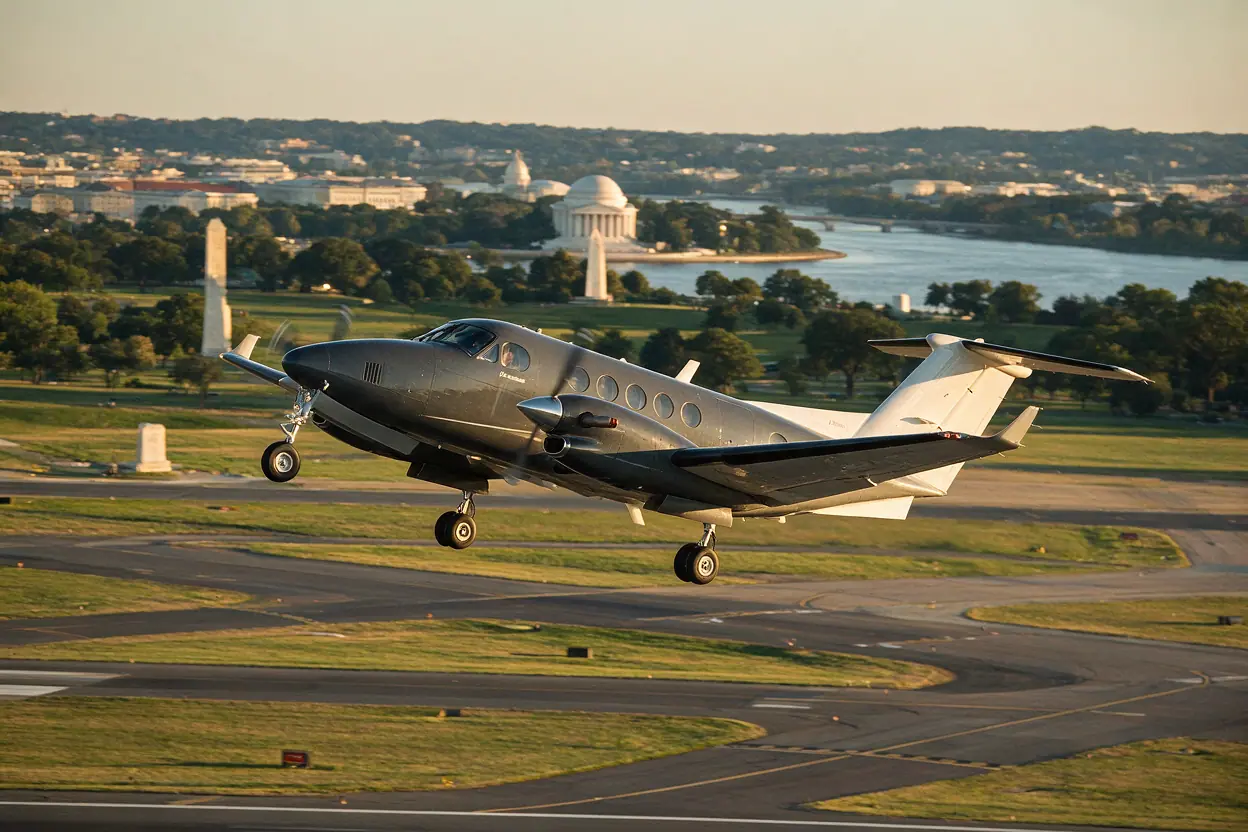
For most parties of one to six, the turboprop is the value pick on this route. Choosing a turboprop on this 158 nautical mile hop keeps estimates near $2,200–$3,500 per aircraft, which is hard to argue with when the jet saves you minutes.
Daher TBM 960
Cabin 4 ft tall, 13 ft 3 in long. Baggage 32 cu ft.
- 6 pax
- 330 kt Cruise
- 1,730 nm max range
Beechcraft King Air 350i
Cabin 4 ft 9 in tall, 16 ft 8 in long. Baggage 55 cu ft.
- 8 pax
- 312 kt Cruise
- 1,800 nm max range
When to book and when prices peak
Jet charter Boston to New York sees demand peak on Monday mornings and Thursday afternoons, when business travel crowds both the airspace and the available aircraft. Friday afternoons in summer add leisure demand on top, and the week before a holiday weekend is the tightest window of the quarter. Booking a Boston to New York turboprop a week or more ahead protects the $2,200–$3,500 estimate range, because short-notice requests pull from whatever is parked nearby.
Same-day round trips are realistic on this distance and are common among people with a single meeting. If you plan to return the same evening, then book both legs together so one aircraft can wait or reposition for you. If your schedule is likely to shift, then a midsize jet at $5,200–$8,000 buys more flexibility in availability than a turboprop, simply because there are more of them moving through the region.
Summer heat affects density altitude at shorter fields, which can trim payload on a hot afternoon out of Morristown. Your provider will flag it if it applies. Otherwise, this route is weather-tolerant and rarely needs the buffer you would build into a longer trip. The one regulator worth naming here is the FAA: when you compare quotes, ask which operator is flying and confirm its Part 135 standing before you commit.
Other jet routes like Boston–New York
The 6 private jet legs here span 194 to 1,191 nautical miles; single-leg turboprop estimates range from $2,200 to $15,500.
This route's common questions
How long is a jet charter Boston to New York in the air?
A light or midsize jet covers the 158 nautical miles in about 41 minutes, a super-midsize or heavy jet in about 39 minutes, and a turboprop in roughly 51 minutes. Those are airborne times only. Add taxi, the drive to the FBO and the drive in from the New York airport, which is where the real saving over commercial flying appears on a route this short.
What does a jet charter Boston to New York cost?
Estimates run from about $2,200 to $3,500 for a turboprop, $4,000 to $6,000 for a light jet, $5,200 to $8,000 for a midsize, $7,200 to $10,000 for a super-midsize and $9,500 to $14,500 for a heavy jet. These are whole-aircraft estimates, not per-person fares, and they rise with short notice, peak days and one-way positioning.
Which New York airport should I land at from Boston?
Teterboro is the usual Manhattan-side choice, with a 6,997-foot runway across the Hudson. LaGuardia, at 7,002 feet, sits closest to Midtown and the Upper East Side. Newark Liberty offers 11,000 feet for larger aircraft, and Morristown Municipal at 5,998 feet serves northern New Jersey meetings. Pick by where your day happens, not by which field is busiest.
Can I do a same-day round trip?
Yes, and it is one of the most common patterns on this route. Book both legs at once so the aircraft can wait or reposition rather than sourcing a second plane in New York. A turboprop from $2,200 to $3,500 each way makes the round trip easy to justify against two sets of airline changes and a hotel night.
Is a turboprop or a jet better on this distance?
The turboprop is the value pick: about 51 minutes in the air against roughly 41 in a light jet, for an estimate starting near $2,200 instead of $4,000. If you need more cabin space or carry a larger party, a midsize jet or the eight-seat King Air 350i covers it. The time saved by a jet here is small enough that comfort and cost should decide.
When should I book for a busy week?
Monday mornings and Thursday afternoons are the peak business windows on this corridor, and holiday weeks tighten availability further. Booking a week or more ahead keeps you in the $2,200 to $3,500 turboprop range. For a same-day round trip, book both legs together so one aircraft serves your whole day rather than two separate charters.